Canada Tax Calculator 2026
Enter your income and the tax already taken off your pay to see whether you get a refund or owe CRA, plus federal and provincial tax, CPP/QPP, EI and take-home pay for every province and territory, using the 2026 brackets published by the Canada Revenue Agency and Revenu Québec.
1IncomeT1 lines
2Deductions & creditsoptional
3Tax already paidfrom your slips
Your 2026 result
Your tax brackets based on taxable income
Compare provinces total tax + CPP + EI
Line-by-line breakdown per year
What is included. Federal and provincial tax brackets, basic personal amounts (with the federal phase-down between $181,440 and $258,482 of net income), the Canada employment amount, CPP/QPP and EI/QPIP credits, the enhanced CPP deduction, the 16.5% Quebec abatement, and Ontario's surtax, low-income tax reduction and Health Premium.
Refund or balance owing. The result compares the tax you owe for 2026 with what you already paid: tax deducted at source (line 43700), instalments, and any CPP or EI overpaid on your T4 slips. Quebec residents file a federal return with CRA and a provincial return with Revenu Québec, so each is shown separately. Provincial donation credits use the lowest and top provincial rates as an approximation; tuition is credited federally only.
Not included. Dividend tax credits, spouse/dependant amounts, disability and caregiver amounts, BC and other low-income reductions, Alberta's supplemental credit, and refundable benefits (GST/HST credit, CCB).
Results are approximate, for illustration only, and are not tax advice. Check your return with CRA, Revenu Québec or a tax professional before filing.
2026 payroll figures. CPP 5.95% on earnings $3,500–$74,600 (QPP 6.40%), CPP2/QPP2 4% on $74,600–$85,000, EI 1.63% to $68,900 (1.30% in Quebec), QPIP 0.430% to $103,000. Self-employed people pay both halves of CPP and no EI.
🇨🇦 Canada Income Tax Calculator 2026 – Estimate Your Refund or Amount Owed
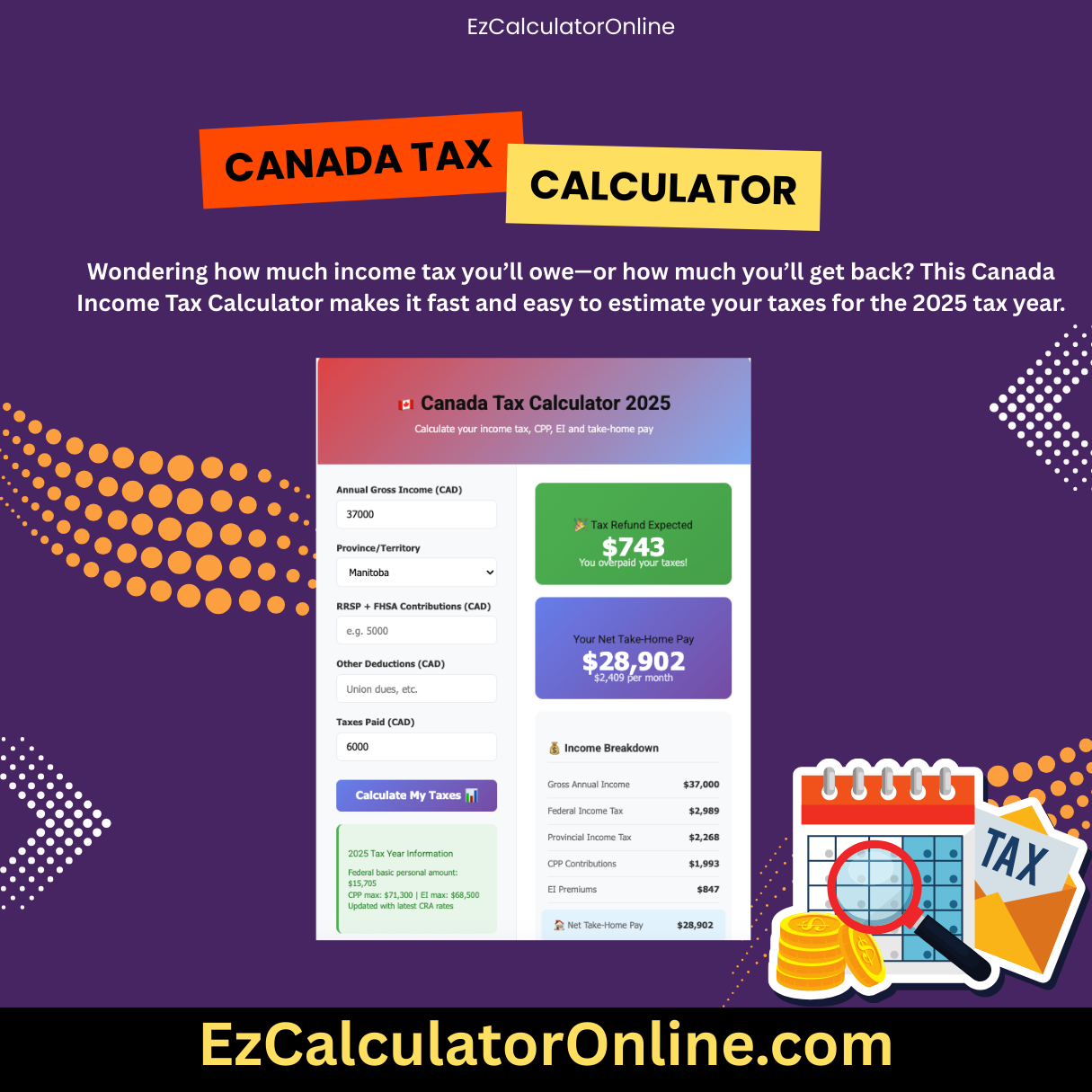
Wondering how much income tax you’ll owe—or how much you’ll get back? This Canada Income Tax Calculator makes it fast and easy to estimate your taxes for the 2025 tax year. Whether you’re an employee, self-employed, or have other sources of income, this tool helps you get a clearer picture of your tax situation.
Simply enter your income, province or territory, and relevant deductions like RRSP contributions, FHSA, charitable donations, CPP, and EI premiums. You can also include taxes you’ve already paid to see whether you’ll receive a refund or need to pay additional taxes.
✅ Why Use This Tax Calculator?
-
✔️ Updated with 2026 federal and provincial tax brackets
-
✔️ Supports all Canadian provinces and territories
-
✔️ Includes common deductions and credits (e.g. RRSP, FHSA, donations, CPP, EI)
-
✔️ Clearly shows if you owe tax or will receive a refund
-
✔️ Mobile-friendly and easy to use—get results in under a minute
-
✔️ Great for personal planning or preparing before you file your tax return
Whether you live in Ontario, Quebec, Alberta, British Columbia, or anywhere else in Canada, this calculator breaks down your estimated tax results based on the latest income tax rules.
🔍 Note: This tool provides a quick estimate only. It does not include every available credit or deduction. For exact results, consult a tax expert or use official CRA-approved tax filing software.
Frequently Asked Questions
It’s an online tool that estimates how much income tax you’ll owe — or how much refund you might get — for the Canadian tax year based on your income, deductions, province/territory, and taxes already paid.
Yes — you can use it without paying or signing up.
All Canadian provinces and territories are included so the results are tailored to your region.
No — it’s an estimator, not official government software. For exact filing, use CRA tools or certified tax software.
Different calculators may use slightly different rates, include/exclude certain credits, or update their brackets at different times — so estimates vary.
Yes — it’s useful for planning, budgeting, or understanding how deductions like RRSP contributions affect your taxes.
You usually enter:
✔ Annual gross income
✔ Province/territory of residence
✔ RRSP and FHSA contributions
✔ Other deductions
✔ Taxes already paid (from your T4)
⭐ Rate this